
About the Journal

cover-jins

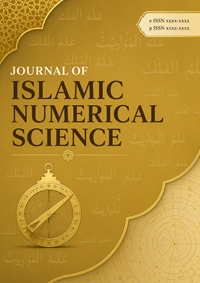
Journal of Islamic Numerical Sciences

Editor in Chief: Mu'tashim Billah

Editorial board

Journal of Islamic Numerical Sciences is a scholarly journal published by Elkuator Research and Publication, issued biannually. The journal specializes in publishing research articles that explore numerical dimensions within Islamic law and science, particularly in Islamic inheritance law (faraid) and Islamic astronomy (‘ilm al-falak).

The scope of the journal encompasses three main areas. First, studies on quantitative calculations in faraid and falak, including methods, models, and computational approaches in determining inheritance distribution, prayer times, qibla direction, and lunar calendars. Second, research on legal thought and juristic reasoning underlying faraid and falak, including methodologies of istinbat al-ahkam, doctrinal debates, and the development of legal interpretations related to numerical aspects. Third, studies on the historical development of faraid and falak, tracing the evolution of theories, methods, and scholarly traditions from classical to contemporary periods.

The existence of this journal is essential in exploring, enriching, and developing both scientific and legal thought, especially in areas where numerical analysis intersects with Islamic jurisprudence. Thus, the Journal of Islamic Numerical Science aims to contribute significantly to the advancement of intellectual discourse in Islamic law and science, particularly in fields involving calculation, measurement, and quantitative reasoning.

This journal seeks to present various results of the latest research, both conceptual-doctrinal and empirical, within the scope of Islamic numerical studies. The editors welcome contributions in the form of scholarly articles to be published after undergoing a rigorous manuscript selection process, including double-blind peer review and professional editing.

The editors invite Islamic scholars, researchers, jurists, and scientists to write and disseminate their research findings related to calculations, legal thought, and historical development in faraid and falak. The views expressed in the articles are those of the authors and do not necessarily reflect the opinions of the editorial board.

rnal is essential in exploring, enriching, and developing scientific and legal thought, particularly in areas where numerical analysis intersects with Islamic disciplines. Thus, Journal of Islamic Numerical Science aims to make a meaningful contribution to the enrichment of intellectual discourse in Islamic law and science, especially in fields that involve calculation, measurement, and quantitative reasoning.

This journal seeks to present various results of the latest research, both conceptual-doctrinal and empirical, in the field of Islamic numerical studies. The editors welcome contributions in the form of scholarly articles to be published after undergoing a rigorous manuscript selection process, including double-blind peer review and professional editing.

The editors invite Islamic scholars, researchers, jurists, and scientists to write and disseminate their research findings related to numerical approaches in Islamic law and sciences. The views expressed in the articles are those of the authors and do not necessarily reflect the opinions of the editorial board.


Aim and Scope

Journal of Islamic Numerical Science focuses on the study, development, and application of numerical, mathematical, and computational approaches within Islamic sciences. The journal emphasizes the integration between traditional Islamic knowledge and contemporary quantitative methods, including digital transformation.

The scope of the journal includes, but is not limited to, three main areas. First, quantitative calculations in Islamic Inheritance Law (faraid) and Islamic Astronomy (‘ilm al-falak), covering methods, models, and computational techniques in inheritance distribution, determination of prayer times, qibla direction, and lunar calendar calculations. Second, legal thought and juristic reasoning in faraid and falak, including studies on istinbat al-ahkam, doctrinal analysis, and the development of legal interpretations related to numerical and measurement-based aspects. Third, historical development of faraid and falak, encompassing the evolution of theories, methodologies, and scholarly traditions from classical to contemporary periods.

In addition, the journal accommodates studies on digitalization and computational Islam, including the development of software, applications, and decision-support systems related to faraid and falak, as part of the broader effort to advance Islamic numerical sciences in the modern era.